

A wedding weekend, with a welcome party the night before, a rehearsal dinner, the wedding itself and a brunch the morning after, is no longer reserved for destination weddings. The Knot's 2027 Wedding Trends Report, released on September 28, 2026, says nearly one-third of weddings now span three or more days. More events mean more guest lists. This guide covers who is usually invited to each wedding weekend event, how to count each list, and how to tell guests what they are invited to without anyone guessing.
Weddings that now span three or more days, according to The Knot's 2027 trends report.
The Knot, September 28, 2026Couples marrying in 2026 who plan at least one extra event, such as a welcome party or a day-after brunch.
Zola First Look Report 2026, 11,500+ couplesCouples planning a full two-to-three-day wedding weekend.
Zola First Look Report 2026How common is a wedding weekend now?
Two of the largest wedding companies in the US measure this differently, so their numbers do not match. The Knot built its 2027 trends report from what couples searched, saved and bought on its sites from January through June 2026, reviewed by its editors and vendors, and says nearly one-third of weddings now run three days or longer, with courthouse ceremonies, welcome dinners and day-after brunches each treated as an event of their own. Zola asked more than 11,500 couples marrying in 2026 for its First Look Report: 37% plan at least one additional event, and 18% a full weekend of two to three days.
Either way, a large minority of couples is planning more than a ceremony and a reception. Esther Lee, The Knot's editorial director, described the longer celebration to TODAY as "an extension of hospitality and caring for your loved ones."
Who is usually invited to each event
Only one of these events has a traditional guest list, and there is a lot of room around it. For the rehearsal dinner, the Emily Post Institute lists the traditional guests as the couple, all attendants and their spouses or partners, the parents of young attendants, close relatives, and the officiant and his or her spouse. Out-of-town guests, it says, can be invited if budget and circumstances allow, "but it's by no means a must." If you leave them out, it suggests recommending a good local restaurant or arranging a separate gathering for them instead.
| Event and who is usually there | Where it goes |
|---|---|
| Rehearsal dinner: wedding party, partners, parents of young attendants, close family, officiant | Personally |
| Welcome party: everyone, or travelers only (then a separate message to them) | Invitation |
| Wedding day: your full guest list | Invitation |
| Day-after brunch: everyone, family, or house guests (then a separate message) | Invitation |
The rehearsal dinner list follows the Emily Post Institute. The other rows are common choices, not rules.
Who hosts matters too, because the host usually decides the size. The Emily Post Institute's page on the rehearsal dinner calls it "customary, but not obligatory" for the groom's family to host, and says the bride's family, the couple, or both families together can host instead. Agree on the list with whoever is paying before anyone books a room.
The welcome party and the brunch are yours to shape. Some couples open them to everyone so guests meet before the wedding; others keep them to travelers or family. What matters is that the line is easy to explain: "everyone staying in town" is easy to explain, while a list picked name by name is the one that leaves guests comparing notes.
Count each list before you book the room
Rehearsal dinners grow quietly, because every attendant brings a partner. Here is a worked example, our own arithmetic, for a wedding of 117 guests, the average The Knot reported in its 2026 Real Weddings Study. Swap in your own numbers line by line.
| Rehearsal dinner list | Count |
|---|---|
| The two of you | 2 |
| Six attendants and their partners | 12 |
| Parents of a flower girl and ring bearer | 4 |
| Parents, siblings, grandparents | 10 |
| Officiant and partner | 2 |
| Total | 30 of 117 guests |
Illustration only. The attendant and family numbers are assumptions; replace them with yours.
Thirty is about a quarter of the wedding list, for one dinner. Adding every out-of-town guest can double it, and Emily Post treats them as optional. If the dinner is getting large, a separate, simpler welcome drink for everyone who traveled is a common middle path. The Knot's study put the average wedding cost at $292 per guest in 2025; a welcome party is usually lighter than that, but it is still a second headcount, and our guide to wedding cost per guest shows how quickly each added name adds up.
Tell each guest exactly what they are invited to
Mixed-up guest lists usually come from one place: the invitation everyone receives lists an event only some of them are invited to. The simplest rule is that the shared invitation shows only what everyone is invited to. A smaller event gets its own message to the people on that list. For the rehearsal dinner, Emily Post suggests sending invitations three to six weeks ahead with directions, and says a handwritten note, a phone call or an email all work.
- On the shared invitation: every event open to all guests, each with day, time, place and what to wear.
- Separately: the rehearsal dinner, and any event for family or the wedding party only.
- For travelers: the welcome party time next to the hotel details, so they can plan their arrival around it.
- For everyone: one clear end time for the weekend, so guests know when to book the flight home.
Dress is where a weekend needs the most detail. The Knot's report notes that couples now treat each event as its own occasion, with its own fashion and design, so guests need to know what to wear to each one. I've spent more than fifteen years behind a camera, a lot of it at weddings. Once I was on the phone with the bride asking for the exact address, and her maid of honor was calling on the other line to ask about the dress code. With three events, that call happens three times unless each one has its dress written next to it.
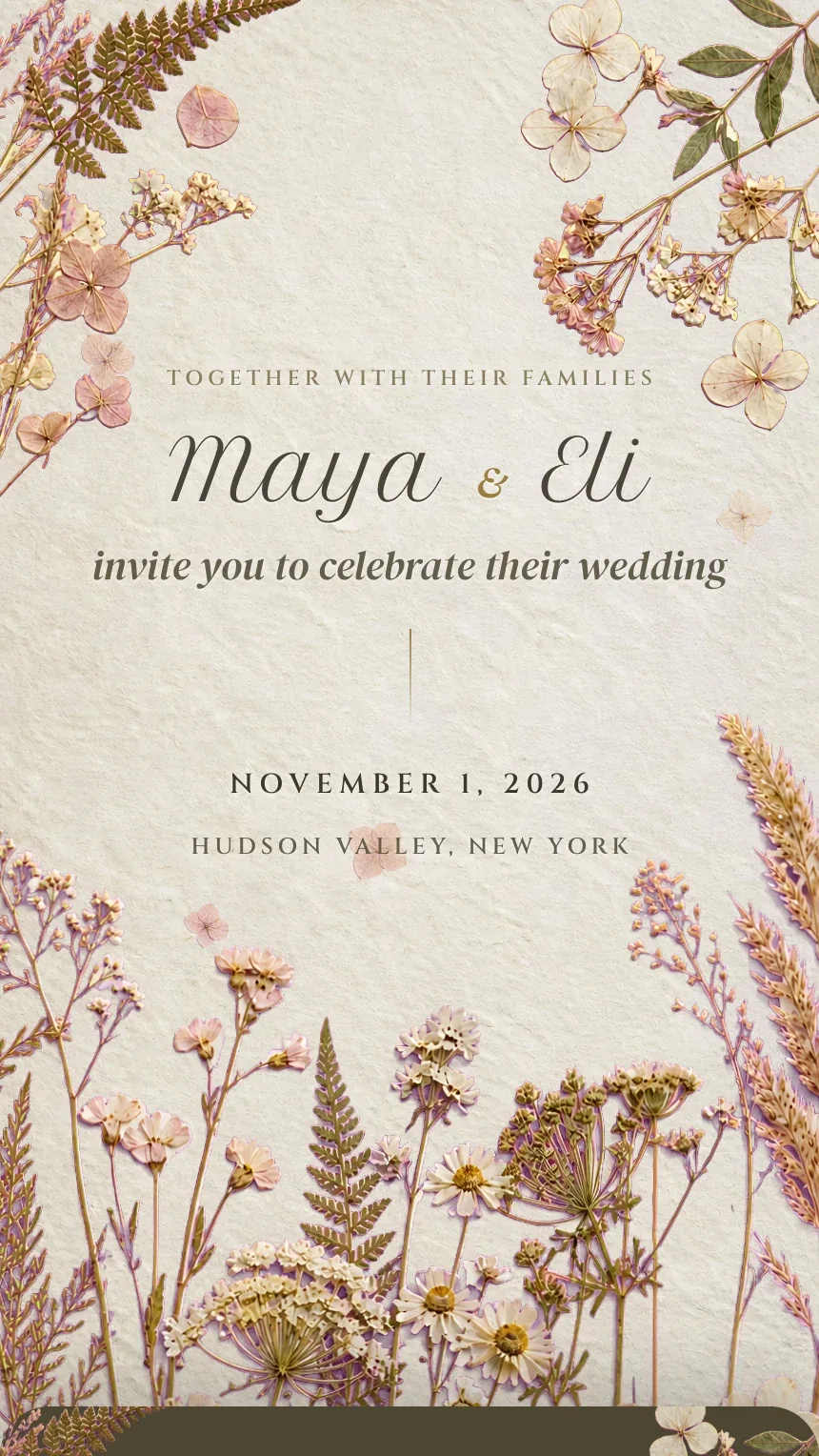
On The Digital Envelope's Classic and Signature digital wedding invitations, the Order of the day section lists each moment with a time, a name and a short note. The section heading shows the wedding date, so for an event on another day, write the day into the time, such as "Friday, 7 PM". The note can carry the place and what to wear. Everyone who opens the link sees the same page, so it holds the events open to all guests, and the rehearsal dinner stays a personal invitation. For what else belongs on the invitation itself, see what to put on a wedding invitation.

When guests travel, plan the weekend around their arrival
A welcome party on Friday evening only works if guests know about it before they book. Put it in the save the date or right after, together with the hotel. If you are holding rooms, our guide to wedding hotel room blocks covers how many nights to hold, and for weddings abroad, destination wedding invitations has the longer timeline. Brunch the morning after works best with a wide window, such as ten to noon, so guests with early flights can stop by and leave.
Everything in one place, so nobody has to call you. Each event, its time, its place and what to wear, in the invitation your guests already have.
See the designsHow we put this together. On October 7, 2026 we read The Knot Worldwide's release on its 2027 Wedding Trends Report (September 28, 2026), TODAY's article on the same report (September 28, 2026), Zola's 2026 First Look Report, The Knot Worldwide's release on its 2026 Real Weddings Study (February 18, 2026), and two Emily Post Institute pages on the rehearsal dinner: its guide to hosting and invitations, and its answer on inviting out-of-town guests. The rehearsal dinner count is our own illustration, with every assumption shown. Every figure was checked against the original page before publishing.
- The Knot Worldwide, The Knot 2027 Wedding Trends Report: Couples Embrace Italian Beach Clubs, The Silver Age, and Maximizing Every Moment, September 28, 2026
- TODAY, 20 Wedding Trends to Look Out For in 2027, According to The Knot, September 28, 2026
- Zola, 2026 Wedding Trends: Zola's First Look Report, read October 7, 2026
- The Knot Worldwide, The Knot Worldwide Unveils 2026 Real Wedding Study, February 18, 2026
- Emily Post Institute, The Rehearsal Dinner, read October 7, 2026
- Emily Post Institute, Inviting out-of-towners to the rehearsal dinner, read October 7, 2026
Questions people ask
- Do you have to invite all wedding guests to the welcome party?
- No. Some couples invite everyone, others only guests who traveled or are staying nearby. Pick a line you can explain in a sentence, such as everyone staying in town, and apply it to the whole list.
- Who should be invited to the rehearsal dinner?
- Traditionally the couple, the attendants and their partners, parents of young attendants, close relatives and the officiant with a partner. The Emily Post Institute says out-of-town guests can be invited if budget and circumstances allow, but it is not required.
- Who pays for the rehearsal dinner?
- By custom the groom's family, though Emily Post notes it is not an obligation. The bride's family, the couple, or both families together can host, and the host usually has the biggest say in how many people come.
- How many days is a wedding weekend?
- Usually two or three. By The Knot's count, close to a third of weddings last three days or longer; in Zola's 2026 survey, 18% of couples planned a full weekend. The difference comes from how each company measured it.
- How do I tell guests about several wedding events?
- List every event open to all guests in one place, each with the day, time, place and dress code. On The Digital Envelope's Classic and Signature invitations, those go in the Order of the day, where the time can be written in words, such as Friday, 7 PM.
- When should guests hear about a welcome party?
- Before they book travel, so with the save the date or soon after. Guests flying in plan their arrival around the first event, not the ceremony.