

There was a moment, somewhere around the time offices stopped printing memos, when a wedding invitation on a screen felt like a shortcut. You could tell the couple had not gone to the trouble. The paper was the trouble, and the trouble was the point.
I understood it then and I understand it now. An invitation is not information. Guests already know you are getting married. It is a gesture, and gestures are judged by their cost. So the question people are really asking, when they ask whether a digital invitation is tacky, is this: does it look like you cared?
What the worry was made of
Two things, mostly. The first was the e-card of the early internet: a jpeg of a scanned invitation, or worse, a form with a drop-down for "number attending" and a logo of the company that made it. The second was the medium itself. Email was for work. Text was for logistics. Neither felt like a place for a wedding.
Both of those have quietly changed. The phone in a guest's hand is now where they read letters from their mother, where they keep photographs of their children, where they said yes to the last three dinner parties they went to. It is where their life is.
The worry was never about screens. It was about effort, and whether the guest could see it.
Which is fair
What guests actually experience
Ask a guest what they remember about a wedding invitation and they will describe a feeling, not a material. "It was so them." "It was elegant." "It made me want to go." Hardly anyone says "the cardstock was 120 pound." The material was the delivery system for the feeling, and for a long time it was the only one we had.
A digital invitation done well delivers the same feeling by different means. It arrives with their name on it. It opens, rather than simply appearing. There is music, if you want music, and there is the same restraint in the words. And then it does something paper cannot: it answers the guest's next question without a stamp. Yes, I am coming. Two of us. She does not eat shellfish.
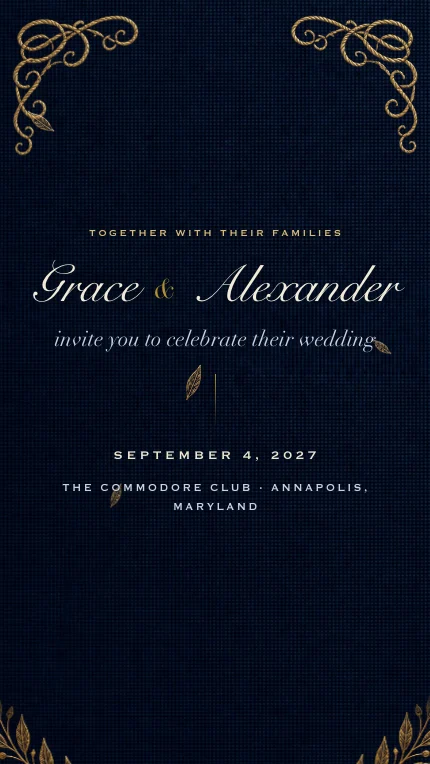
The four things that decide it
Having watched a great many invitations go out, I would say the tacky ones fail in one of four places, and none of them is the screen.
- A form where a letter should be. If the first thing a guest sees is a field to fill in, it is an admin task, not an invitation. The reply should come after the beauty, not instead of it.
- Somebody else's logo. An invitation that advertises the company that made it has stopped being yours. The maker's name, if it appears at all, belongs at the very end, small, the way a printer's mark sits on the back of a card.
- Design that tries too hard. Confetti that never stops, five fonts, a countdown clock the size of a billboard. Paper invitations are restrained because restraint is what elegance looks like. Screens do not change that.
- Sending it like a spreadsheet. A mass email with forty addresses in the CC line is tacky in any century. A message to each household, with their name, is a letter.
Where paper still wins
I will not pretend otherwise. A letterpress suite in a lined envelope, hand-addressed, is an object, and objects can be kept in a drawer for forty years. If your wedding is formal in the older sense, if your grandmother will want to frame it, if the budget allows for the whole suite and the postage twice over, paper is not tacky either. It is lovely.
But most couples are not choosing between letterpress and a link. They are choosing between a template ordered online, printed on stock they never touched, mailed with a reply card they will spend three weekends chasing, and a page that opens like a letter and does the chasing for them. Put that way, the answer is less about taste and more about where the effort goes.
A test you can run yourself
Send one to yourself and open it the way your aunt will: on the phone, from the message, not the preview on your laptop. Does it feel like something arrived, or like something loaded? Does it look like your wedding or like a product? Would you be glad to receive it?
If it passes, send it, and stop worrying. The guests decided this question a while ago. They are only waiting for the date.
Questions people ask
- Is it rude to send a wedding invitation by text?
- Not if the text carries a proper invitation. A bare message with the details is a note; a link that opens into a designed invitation with your names and the reply on the page is an invitation. The medium is the phone either way.
- Will older guests be able to open a digital invitation?
- Yes, as long as it is a plain link that opens in the phone's browser, with no app and no account. Anyone who reads messages from family can open it. For the very few who do not use a phone, a printed copy of the same design solves it.
- Do digital invitations look cheap?
- Some do, in the way that some paper invitations look cheap. The tells are a form before the beauty, another company's branding, and design that shouts. Restraint and a proper opening make the difference.
- Can a digital invitation be formal?
- Completely. Formality lives in the wording and the design, not in the paper. "Request the honour of your presence" reads the same on a screen, and the reply can still be by household.
- What about people who like to keep invitations?
- Let the link live on. A digital invitation does not expire; months later it still opens, and the photos your guests added stay online for a year after the wedding.